Evil Dead Burn: A franchise in ashes?

By Neve Jacqueline Thomson

Edited by Joanna Yang

Warning: Discussion of film depictions of domestic violence. Some minor spoilers for the film.

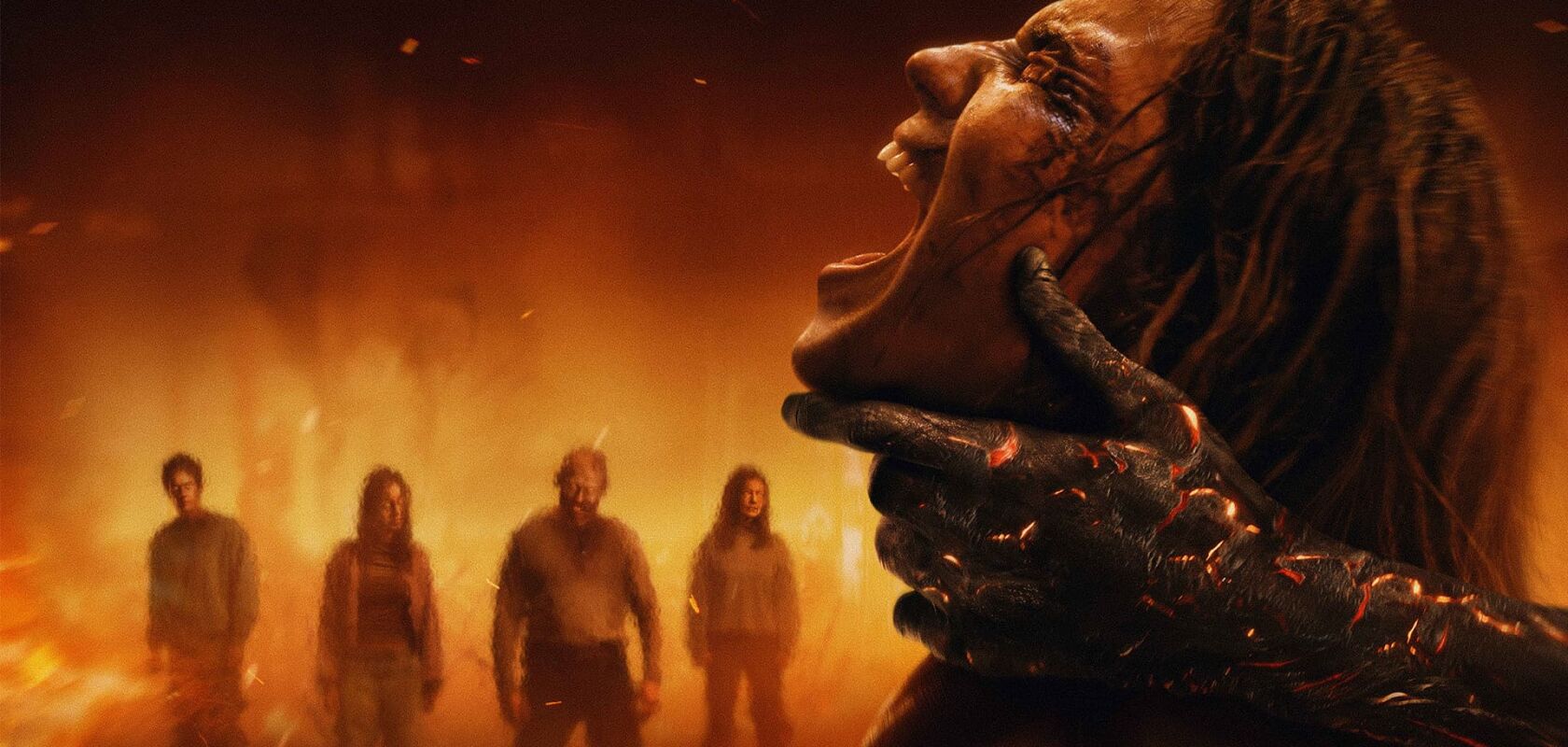
Earlier this year I wrote an article about seeing the Evil Dead musical. One thing I really appreciated about the musical was its decision to lean into what I consider the bread and butter of the Evil Dead franchise, its unrelenting commitment to goofiness. Whilst the goofiness within the franchise took a slight hit in the 2013 remake of the original film, I’ve felt that the more recent Evil Dead film, Evil Dead Rise (2023), had taken a page out of the Necronomicon of the original trilogy and television series, and allowed comedy to sit beside horror as equally important elements of the franchise. The films have never been unrelentingly cruel or gory, instead they always allow moments of levity. Importantly, the deadites were always up for a bit of banter, which conversely somehow made them more terrifying. The most recent release in the franchise, Evil Dead Burn (2026), seems to steer away from this approach however, leaning more into extreme horror. 

Prior to seeing this film I was informed by the internet and close friends that it was a very “French” film. Whilst I thought that was a strange thing for an Evil Dead movie to be, I was admittedly a little bit excited. As a student of the French language, I considered it to be an opportunity to do some listening practice, and potentially have it be a nice double feature after watching La Haine (1995) the night before. What I didn’t realise was that the “Frenchness” of the film was not just in the inclusion of Swiss (French speaking) actress Souheila Yacoub as our main character “Alice”; nor the use of the French language intermittently throughout the film, but also its “New French Extremity” influence, a genre known for its controversial yet highly regarded directors such as Gaspar Noé. French director, Sébastien Vaniček, has stated that “[créer un film] hyper brutal et violent, c’était mon objectif” ([creating a film that was] extremely brutal and violent, that was my goal). This goal seems in line with the New French Extremity movement’s focus on depictions of extreme violence, with the aim of shocking the audience. There is a lot of debate as to whether or not this genre is presenting violence for a genuine purpose within film, if there is some artistic merit to these depictions, or if its only purpose is making audiences clutch their pearls. After watching Evil Dead Burn, and even now writing this article, I wonder whether the underlying meaning justifies the end product of the film.

A common comment I have seen about this film is that it is mean-spirited, and I have to agree. It is unrelenting in its brutality and I don’t think the underlying metaphors and analogies make up for how intense the violence is. The violence did not feel purposeful, it felt like it was included simply to shock, which aligns with the directors goal. In that sense, it was successful, but I don’t think that makes it a successful film. 

The film centres on the complicated grief our main character has around the death of her husband, who was physically and verbally abusive to her during their marriage, and whose family appears to be blissfully unaware of the reality of their marriage. Our main character is geographically isolated from her family in Paris, linguistically isolated amongst anglophones, and is blamed for the death of her late-husband by his family. We get hints throughout the film that this family has an internal history of violence, based on the way the husband's father appears filled with silent rage even before he is possessed by a deadite. Strangely, the house, family and themes of violence were all very reminiscent of the Resident Evil 7 game’s theme and vibe. Overall, this film's exploration of the cycles of violence, the isolation of survivors, and what one must push through to even begin to heal is evident. 

However, as I watched the film, I questioned whether audiences really wanted to see a survivor of domestic violence being subjected again and again to extreme violence, even in a supernatural sense, to depict a metaphor of survival. The main character Alice is tormented, physically and psychologically throughout the film, in an attempt to depict a catharsis and a story of survival, however, I am torn on whether it truly achieves this. There was something about the story and the decisions made by the writer/director that felt shallow, as though the goal was not to truly depict the levels of grief and catharsis that come from survival and use the New French Extremity approach to force the audience to emphasise with and feel this as they watch the film. Instead, its purpose seemed simply to shock. 

Considering this is an Evil Dead film, it may be naive to expect some kind of underlying deep exploration of the psychological impacts of domestic violence and what the pathway to healing looks like for survivors from an Evil Dead film (the same franchise that brought you time travel, mini versions of Bruce Campbell, and a chainsaw hand). However, I wouldn’t have expected this if the movie had not set the audience up to be invested in the survival story of our main character. My belief is that if you are going to justify your use of this extreme horror by wrapping it within a grounded concept such as domestic violence and a story of survival, it should be well depicted, honest, and genuine, otherwise it borders on being insulting. 

This brings me to my second issue with this film, due to its approach and subject matter, there is not a single bit of levity throughout it. I agree there were attempts at humour, but I found all of them fell flat and felt awkwardly placed throughout the film. Much of the attempted humour surrounds a grandmother who appears to have some form of dementia, and forgets who the people within the home are. Again, these are attempts at humour, and they did not manage to get even a sympathetic chuckle out of me. The humour honestly felt as though the writers had been told to include a few jokes after writing the entire script, and just chucked in a few comedy bits haphazardly. Importantly, considering the subject matter, the inclusion of this kind of humour throughout most of the movie was very misguided and tonally incorrect. This is a consequence of the movie being pigeonholded into its New French Extremity approach, losing the humor I enjoyed from previous adaptations.

Overall, if you are looking for a film to torment your squeamish friends with on a Saturday night, Evil Dead Burn will be just fine. However if you want to have a real Evil Dead experience and a good time, you are better off popping on Army of Darkness and having a bit of a laugh. If you are looking for a movie that explores serious topics such as domestic violence with nuance, I cannot recommend Evil Dead Burn. Its attempt at humor, constant violence towards the main character, and generally lack of empathy fails to say anything.

Importantly, if you have played Resident Evil 7, you can skip this film, because it is basically just that game in movie form. 


Neve Jacqueline Thomson is currently studying English, French and Education. She loves to read, watch and write about the horror genre and speculative fiction. 


Read More From The Blitz Archive

Are You Starting To Think The Rat From Flushed Away is Attractive?: The Rise of The 'Rodent Boyfriend'

Juno breaks down the bizarre trend of the 'Rat Men' taking over the internet.

Read More

Top 10 Australian Advertisements

Eloise goes down memory lane to recount some of the best and most iconic Aussie Ads that are etched in all our memories.

Read More

A Definitive Ranking of the Beloved Papa Louie Games

Alexa ranks our the childhood cult classic, Papa's Pizzeria games.

Read More

Read More