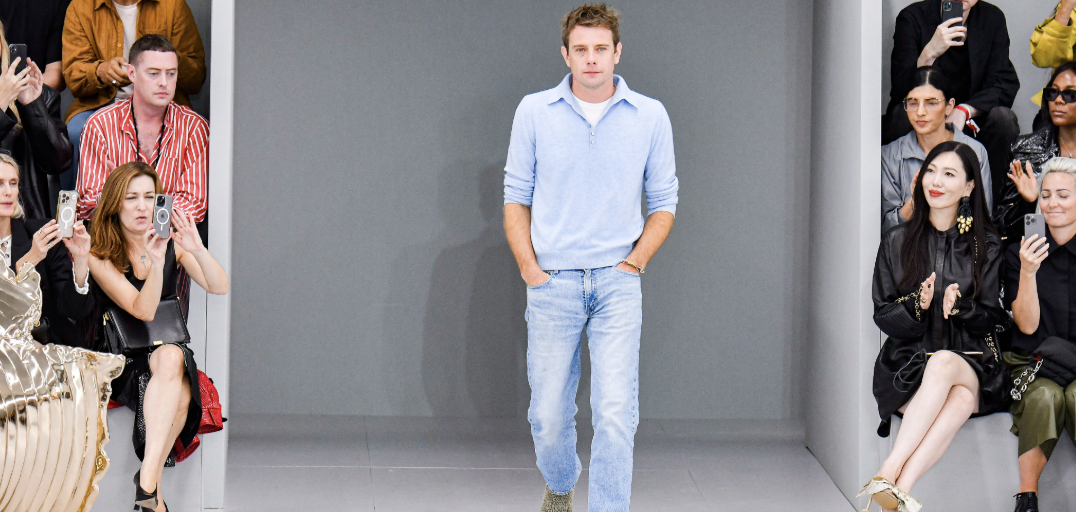
However, Anderson is not just contributing new ideas to Dior; he is also bringing his now widely recognised expertise in strengthening brand identity. Before heading Dior, Anderson’s stint at Loewe transformed the brand from a luxury B-lister into a unified Italian cultural movement, sparked by the viral popularity of the Anderson-designed “puzzle bag”. Though Dior doesn’t require the creation of a new identity, as Loewe did, Anderson has spent much of his early shows blurring the line between men’s and women’s fashion. By designing men and women’s collections in tandem, Anderson has created a new entity known as the “Dior couple” which reflects a push towards a modern, progressive vision that breaks down lines between how clothing should be worn by men and women.
“ It’s a modern vision: You can see the look on men and women with an interchangeability,” said Dior’s chair CEO, Delphine Arnault, to Vogue earlier this year. “It is also a vision that Anderson has pursued from his earliest days as a designer at his own brand, when, in 2013, he caused a stir by bringing into his men’s collection a pair of ruffle-bottom shorts with a miniskirt silhouette.”
Anderson’s vision allows him to occupy an increasingly rare position, a creative director whose relevance isn’t confined to fashion spaces. Over the past few months alone, I have encountered social media posts where commenters discuss not only Anderson’s work but also his image as a designer. To the untrained eye, Anderson looks as though he dresses quite conservatively. This idea naturally sparked conversations online, as people typically expect fashion designers to be visually bold, yet Anderson’s understated image is one of his defining characteristics: the ability to discuss and approach luxury fashion in a way that appeals to the average person and feels non-judgmental. You don’t have to walk down a runway in Paris to bring “radical-ness” into your own life.
As the son of a professional rugby player, it would have been easy for Anderson to follow in his family's footsteps and be a "traditional man” and yet he has distinctly chosen his own path, a path which radically defies the norms of a typical young Northern Irish man, showing young men around the world that being unapologetically themselves is fulfilling in its own right, and sometimes, professionally rewarding too.
For me, fashion is not just art; it's armour. I could go out in a t-shirt and sweatpants and blend into society's safe and unjudging background, or I can wear clothes that I love and feel confident in, regardless of how they “should be worn” or rather who should be wearing them. Fashion lets me be radical, try something I wouldn't have worn a few years ago, and wear whatever I feel good in because, after all, clothes don’t judge their wearer. Thus, I believe the appeal of Anderson and his work lies in his ability to communicate and unlock the same personal connection to fashion in the average person.
There’s a compelling case to be made that Jonathan Anderson is the defining fashion designer of our time. He has built a reputation on breaking down traditions while still honouring them, reshaping boundaries, and defying the status quo. Most importantly, to someone who looks as supremely average as myself, Anderson represents hope. Hope that the clothes you wear signal the self, as opposed to status, and hope that anyone, regardless of what traits they were born with, can be themselves, confident and radical.
If fashion is my armour, then Anderson is a mythical king who bestows upon his knights the strength and tenacity of his own vision.