Adding on to that, what do you see as the value of the relationship between the two characters in the book?
I mean, we can keep peeling the onion back, right? Keeping in mind the first part of that answer, it almost does not matter how much I'm like that character or how much my partner is like the Yuan on the page. They might almost as well have been given different names. Of course, I say almost because that's not true. But, there was more of a sense that the driving purpose behind these two characters sets aside their identity, who they really are, what sort of real-life stories, anecdotes, and experiences were sort of filtered through them. Which I can say is not zero. But the author's real goal was to capture two characters falling in love in real time. And that is almost a bridge that readers could cross.
I hazard a guess that you enjoyed both parts of the narrative. But there are a lot of people, I know from negative reviews, who read the book and could not care less about one part of the book. And so there was almost this idea of the couple being a drawstring to get readers across the line.
You know, it's a weird book. It's structured in a way that, while not unique by any stretch of the imagination, is not typical. And so, the core part of it was: how can I get the reader invested in 2 characters and the will-they-won’t-they of it, while perhaps accepting the expectation that things will be tied up and resolved and everything will connect. And that to me is very true. Everything does connect, and for readers who pay attention, or do the homework, which is more of a pejorative phrase. You know, that is very much there.
But again, there are many readers for whom even the idea of it is offensive. They think, "Why would you want me to jump through these hoops to make meaning? This isn't what I'm used to, and I don't like this." And that's all okay.
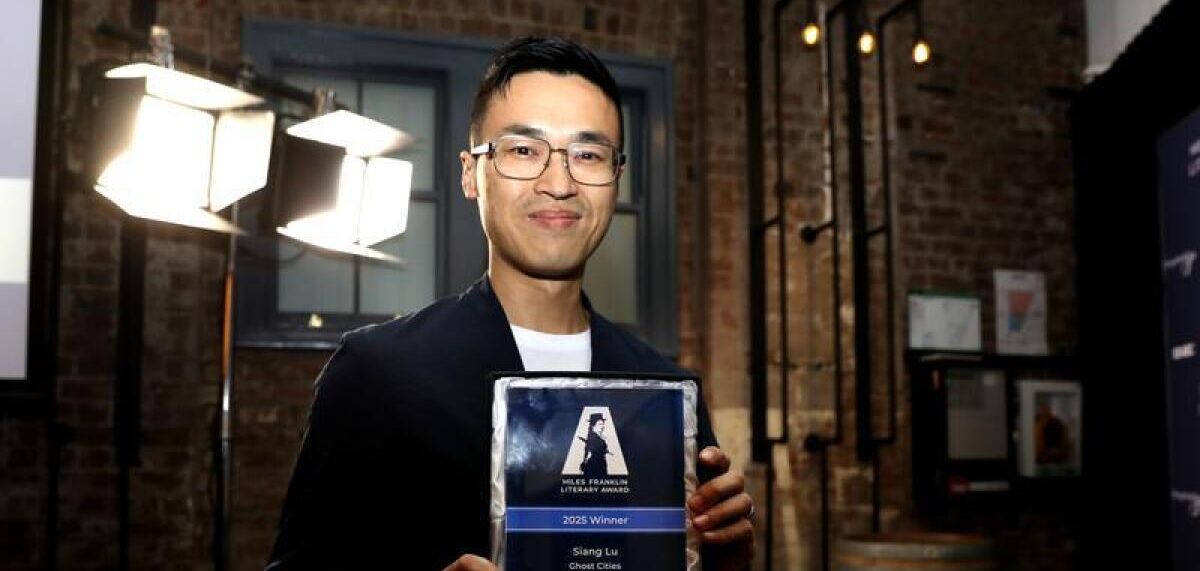
You know, it's been a really interesting ride: the Miles Franklin, having this spotlight shone on me through the book. In particular, the book, which I can conveniently hide behind, receives a lot of love, but also many readers who have not enjoyed it at all. And I do say that the reader, like the customer, is always right. If it's the worst book you've ever read, you are correct. And if it's a great book in your estimation, you're also correct. And this is an impossibility, almost like Zeno's paradox. But as much as it has to do with me, insofar as I wrote the book, it almost has nothing to do with me and more to do with what the reader is expecting and what sort of baggage they bring to it.
I wanted to discuss your writing process. In Ghost Cities, there are so many signs, symbols, and images that are incredibly dense with meaning, becoming even more so as they recur throughout the novel. For instance, some images from the book that really stuck with me were the funeral procession followed by a honking taxi and the one thousand simulations of the emperor.
So I'm curious: as you were writing, were you thinking about all the potential meanings that could be interpreted from these images, or were you simply creating images and letting them take a life of their own?
There are some that are absolutely constructed in that way. The ones that you mentioned were. There is one that, for whatever reason, I was continually drawn to and so deliberately wanted there to be a repeated image of an object that had a ruined centre. I just felt somehow it would be satisfying to me if no one else.
And so the artwork that the artisan creates for the emperor has that. The labyrinth, arguably, has that as well. Later on in the village, when the villagers found this broken clock, it was broken in exactly the same way.
I remember thinking that I had almost intended for the entire book to be one of those objects, actually. So to like ruin—probably the wrong word, maybe it's the right word—expectations. Just when you're hoping that the book will start to cohere, and I'm smiling because it's almost perverse, but when you're hoping for things to start connecting, in fact, by the middle of the book, things get weirder and weirder still. For whatever reason, I think a creative is drawn to certain images, signs, and symbols. I've always found that in the repetition of those signs and symbols, that's when you get at something that's truly meaningful.
Finally, a lot of the people reading this will be student writers. Do you have any advice for young writers trying to get into the industry?
Read every day, write every day. Read widely. And if you want it, give it.